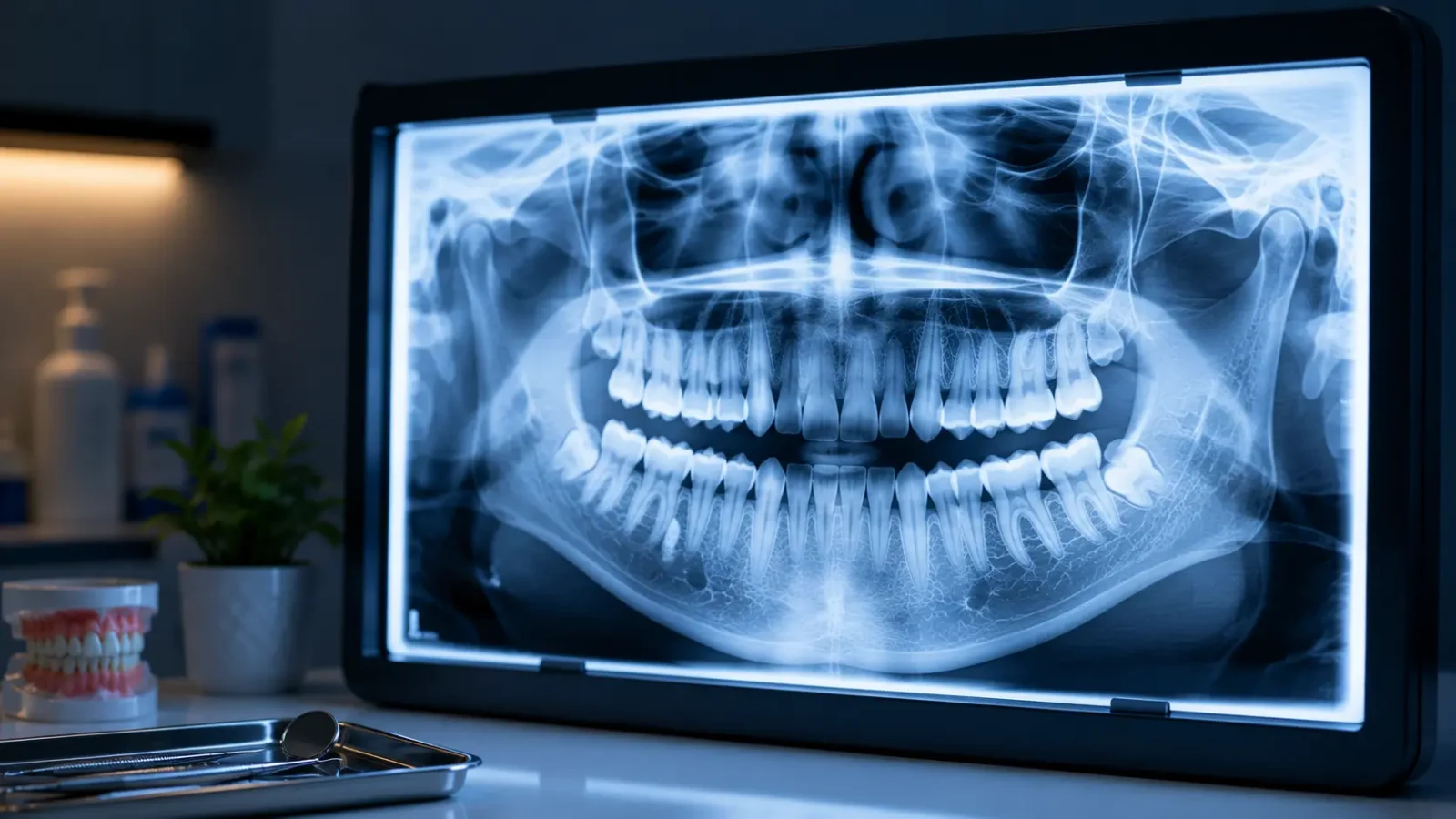
Dental X-rays show what an examination alone cannot - decay hidden between teeth, infection at the root, bone levels, and unerupted teeth. They’re one of the most useful diagnostic tools in dentistry, and modern digital versions use very low doses of radiation. Here’s what each type shows and how safety is managed.
X-rays most often confirm decay between teeth, where a brush and mirror can’t reach. Our cavity-prevention guide explains how to protect those surfaces.
Why X-rays Are Taken
- Decay between teeth or beneath existing fillings
- Infection or abscess at the root tip
- Bone levels around the teeth in gum disease
- Position of wisdom teeth and other unerupted teeth
- Planning for implants, extractions, or orthodontics
- Checking the development of children’s adult teeth
The Main Types
- Bitewing - shows the crowns of upper and lower back teeth together; the standard check for decay between teeth
- Periapical - shows one or two whole teeth including the root tip; used for pain, infection, and root canals
- Panoramic (OPG) - a single wide image of all the teeth and both jaws; used for wisdom teeth and overall planning
- Cephalometric - a side view of the skull used in orthodontic planning
- CBCT - a 3D scan used selectively for implants and complex cases
Key fact: The radiation dose from a routine dental X-ray is very small - comparable to the natural background radiation you receive over a short period of ordinary daily life. Digital sensors have cut doses substantially compared with the old film systems.
How Safety Is Managed
- X-rays are taken only when there is a clinical reason, never as a routine ritual
- Digital sensors keep the dose as low as reasonably achievable
- The beam is tightly limited to the area being examined
- Protective shielding is available and used as a precaution
- Previous X-rays are reviewed to avoid unnecessary repeats
- Pregnancy is always discussed beforehand
X-Ray Types at a Glance
| Type | What It Shows |
|---|---|
| Bitewing | Decay between back teeth |
| Periapical | A whole tooth, including the root |
| Panoramic (OPG) | All teeth and both jaws |
| Cephalometric | Profile view for orthodontics |
| CBCT | 3D view for implants and complex cases |
⚠ Important: Always tell your dentist if you are pregnant or think you might be. Dental X-rays are not usually a risk to a pregnancy, but non-urgent images are commonly postponed as a precaution, and extra shielding can be used when an image is genuinely needed.
Due for a check-up?
At The Dentart, Sarjapura, Bengaluru, we take X-rays only when they’ll genuinely help your diagnosis - and we’ll always explain why. Book your check-up today.
Frequently Asked Questions
X-ray questions our patients in Sarjapura ask most.
Are dental X-rays safe?
Yes. Modern digital dental X-rays use very low doses, are taken only when needed, and are used with shielding as a precaution.
How often do I need them?
It depends on your risk of decay and gum disease. Some people need bitewings every year or two; others far less often.
Can I refuse an X-ray?
Yes, it’s your choice - but be aware that decay between teeth and infection at the root often can’t be diagnosed without one.
Are X-rays safe for children?
Yes, when clinically justified. Doses are adjusted and images are taken only where they’ll change what we do.
Do I need X-rays if nothing hurts?
Often, yes. Decay and bone loss are painless in their early stages - which is exactly when they’re easiest to treat.
Final Takeaway
X-rays let your dentist diagnose what’s hidden rather than guess at it - decay between teeth, infection at a root, or bone loss that no examination would reveal. Taken selectively with digital equipment and shielding, the dose is very low, and the diagnostic benefit is considerable.
Book a check-up at The Dentart, Sarjapura, and we’ll always explain any X-ray before we take it.
You May Also Find Helpful
Book a Consultation
It’s easy and free!